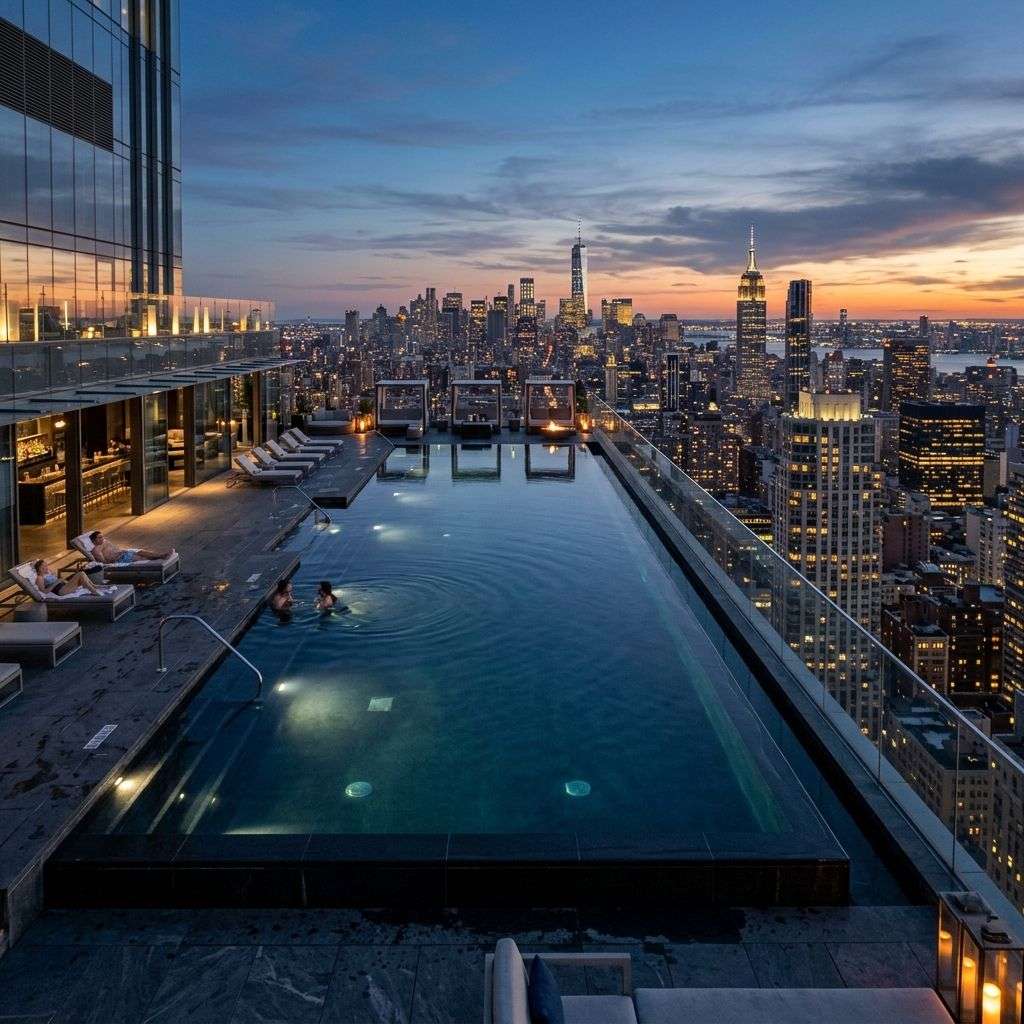
The cantilevered infinity-edge pool has become a signature amenity for premium residential and hotel towers across Gold Coast, Brisbane, and Sydney. Delivering one at 40+ storeys involves engineering considerations far beyond a ground-floor equivalent: wind shear on the wet edge, acoustic isolation from the penthouse below, transfer-slab loading, and hydraulic mitigation against gust-driven water loss. Here's our engineering methodology.
Wind Shear and the Wet Edge
At 150m+ elevation, wind velocities regularly exceed 60km/h gusts. An infinity wet-edge loses water to wind when the thin overflow film is lifted from the weir — causing pool-level drop and eventually plant-room shutdown. Standard residential infinity design uses a catch-tank sized for approximately 8-12% of pool volume. At altitude, we upsize to 18-22% and add baffled wind-deflection lips.
The catch-tank also acts as a structural damper for dynamic water movement — critical for buildings with measurable inter-storey sway.
Acoustic Isolation to Tenancies Below
A rooftop pool's plant room sits directly above an occupied penthouse or top-tenancy. Without proper isolation, pump vibration and water-return noise transfers through the structural slab at measurable levels.
Our method: triple-layer acoustic isolation mounting at all plant points (neoprene base, epoxy-grouted intermediate, spring-isolated top mount) plus a discrete acoustic plenum around the equipment envelope. Tested results on our Horizon Gold Coast project delivered 0 dB measurable transfer to the penthouse below.
Transfer Slab Loading and Structural Coordination
A 20m × 4m pool at 1.4m depth carries 112 cubic metres of water = 112 tonnes, plus tile finish (~8 tonnes) plus structural concrete shell (~80 tonnes) = ~200 tonnes static load on the transfer slab. Wind-induced lateral loads add another 25-40 tonnes dynamic.
Early structural coordination at Stage 01 — before the transfer slab rebar is detailed — is mandatory. Late-stage pool additions to towers whose transfer slab was designed for lighter amenity typically require expensive retrofit columns or change the entire slab design.
Cantilever Verification
The cantilevered portion of the pool — typically the outer 2-4m projecting beyond the structural column line — carries amplified wind loading and requires specific engineering verification. We specify:
- Post-tensioned concrete for the cantilever diaphragm
- Independent wind-load calculation for the extended edge
- Secondary safety glazing verification (balustrade or glass wall)
- Seasonal thermal expansion detailing in the coping
- Wind tunnel testing on projects above 200m elevation
Conclusion
High-rise cantilevered infinity pools demand early structural integration and specialist engineering discipline. Our rooftop and high-rise services cover feasibility through commissioning with dedicated wind-load calculation packages.