
Wahoo Pool Aquatics

Technical Engineering

The Commercial Pool Commissioning Process: 48-Hour Load Testing Explained

Every commercial pool we deliver undergoes a 48-hour continuous-run commissioning test under simulated bather load. Here's what it verifies and why it matters.

Wahoo Principal Engineer · Principal Engineer & Director7 January 20265 min read

Tags

CommissioningHandoverTestingQuality Assurance

Related Services

Construction completion is not the same as operational readiness. A commercial pool that passes its final build inspection can still fail under real bather load due to undersized plant, unbalanced hydraulics, or water chemistry instability at volume. Our 48-hour continuous-run commissioning test simulates peak operational load before handover — catching problems when we can fix them, not three months into an operator's first busy season.

What 48-Hour Testing Actually Means

The test runs the pool plant continuously for 48 hours at full design load, with water chemistry monitored, pump flow rates logged, and filter pressure drops recorded. We simulate peak bather load by intermittent dosing of a standardised organic challenge (representative of swimmer contaminants), testing how the sanitisation plant responds.

For pools with multiple plant circuits — main pool, spa, children's pool — each is tested independently and in combined operation.

What We Measure

The critical metrics:

  • Filtration turnover time vs design specification
  • Free chlorine stability under challenge dosing
  • Combined chlorine (chloramine) formation rate
  • Plant room vibration and noise at full load
  • Pump amperage stability
  • Heater temperature differential under continuous demand
  • Pressure drop across filter media
  • Overflow channel flow uniformity

What Failure Looks Like

Common commissioning failures we catch: chlorine demand exceeding dosing capacity (undersized dosing pump), filter backwash cycles triggering too frequently (undersized filter), heat exchangers unable to maintain setpoint under challenge (undersized heating), or plant room noise breaching design target.

These are all fixable at commissioning — but only because we test under realistic conditions rather than just verifying installation.

Documentation and Handover

Every commissioning test generates a documented report: hourly readings for all metrics, challenge-dosing response curves, plant room noise readings, and sign-off by the commissioning engineer. This report forms part of the client handover pack and becomes the baseline for future operational troubleshooting.

Conclusion

48-hour commissioning testing is standard on every commercial pool we deliver — municipal, hotel, institutional, or estate. The cost is built into our fixed-sum contracts, not treated as an optional extra.
Next Steps

Thinking about a project like this?

What is involved in building a rooftop or high-rise pool?

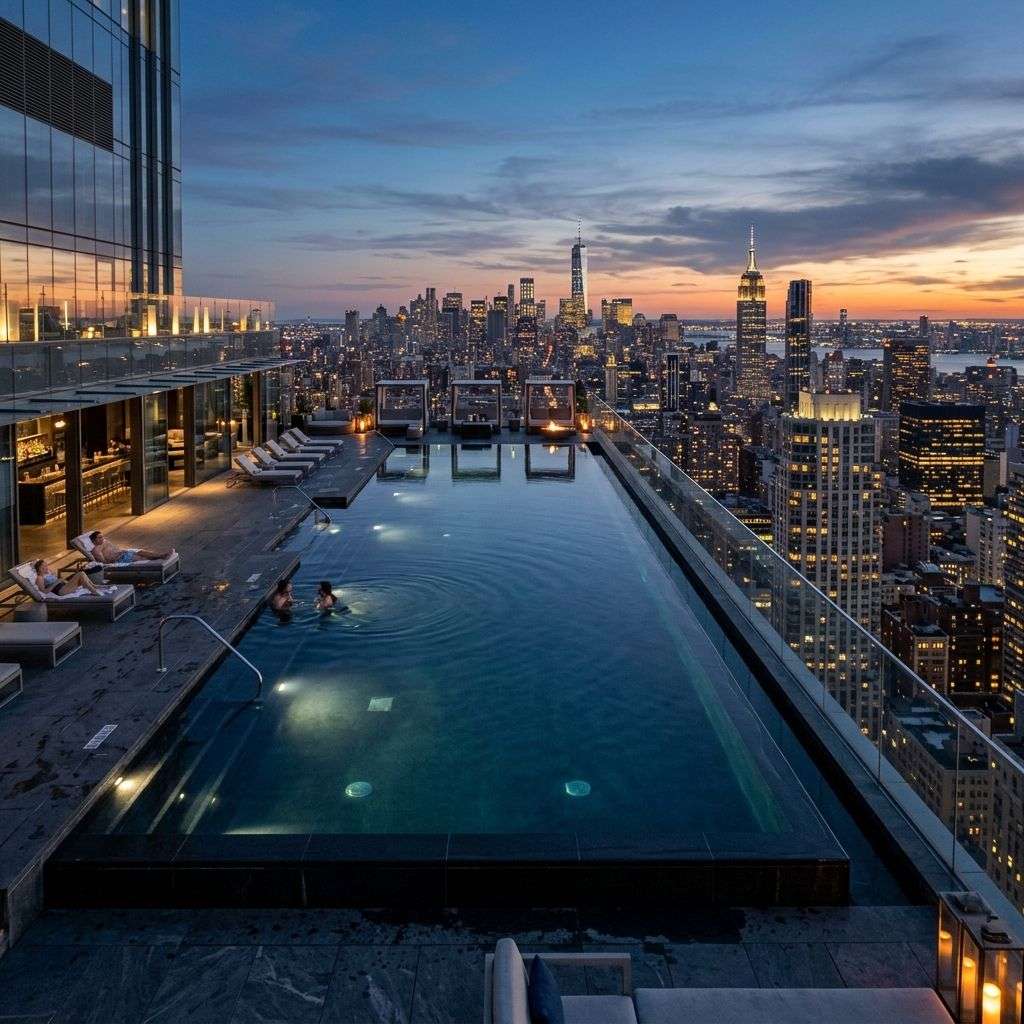
Four constraints dominate. Structural: transfer-slab loading and lateral wind shear at height, which is why the design starts with structural modelling rather than a shape. Acoustic: plant-room vibration must be isolated from the tenancy below, usually with neoprene and epoxy isolation detailing. Waterproofing: a failure over occupied floors is catastrophic, so membranes are fully bonded and commercial-rated rather than domestic. Logistics: every cubic metre of concrete and every plant item is a crane movement inside someone else's programme. We have delivered rooftop vessels on towers above 30 storeys.

How do you construct the pool shell?

A monolithic shotcrete shell, poured as a single continuous operation to eliminate cold joints and substrate weakness — the industry best practice at commercial scale. That is followed by a fully bonded commercial-grade waterproofing membrane, then commercial ceramics or epoxy grouts set to tolerance. On competition vessels the tile setting is surveyed with laser theodolite during the shoot and the finish, because dimensional accuracy has to survive tiling rather than merely exist in the concrete.

How is filtration sized for a commercial pool?

By bather load and statutory turnover, not by vessel volume alone. We design turnovers as short as 30 minutes for high-load facilities such as learn-to-swim and splash play, using sand or glass media, ultra-fine filtration, and UV or ozone sanitisation as the duty requires. Undersized plant rooms and residential-grade pumps are one of the most common causes of forced operational closure in commercial facilities, so the plant room is sized for the busiest realistic day rather than the average.

How much does a commercial swimming pool cost in Australia?

Commercial aquatic construction is highly variable, but the bands we routinely deliver are a useful anchor: from about $500K for a standalone commercial vessel, $2–5M for a high-rise podium or rooftop pool, and $7–9M for a municipal aquatic centre with competition and secondary vessels. What moves the number is structural complexity (ground-level versus a 40th-floor transfer slab), geotechnical conditions, plant sizing for bather load, compliance overlay such as DDA or heritage, and finish specification. We price after engineering, not before, so the figure you receive is the figure the site supports. Send plans through the quote form for a tailored estimate.

How do I get a quote from Wahoo Pool Aquatics?

Two routes. Call 1300 924 666 and speak to the commercial estimation team directly, Monday to Friday 7am–5pm AEST. Or submit a brief through the quote form with your service type, location, project stage and timeline — we respond within 24 hours, an NDA is available on request, and a tailored proposal follows once we have plans. Either route reaches the same estimation team; the phone is faster if you have a tender date.

More detail in all answers, or call 1300 924 666 and speak to the estimation team.

Ready to build?

Partner with Wahoo Pool Aquatics for uncompromising commercial construction. No residential scale, no pricing games. Just rigorous engineering.

Call
Quote
Directions