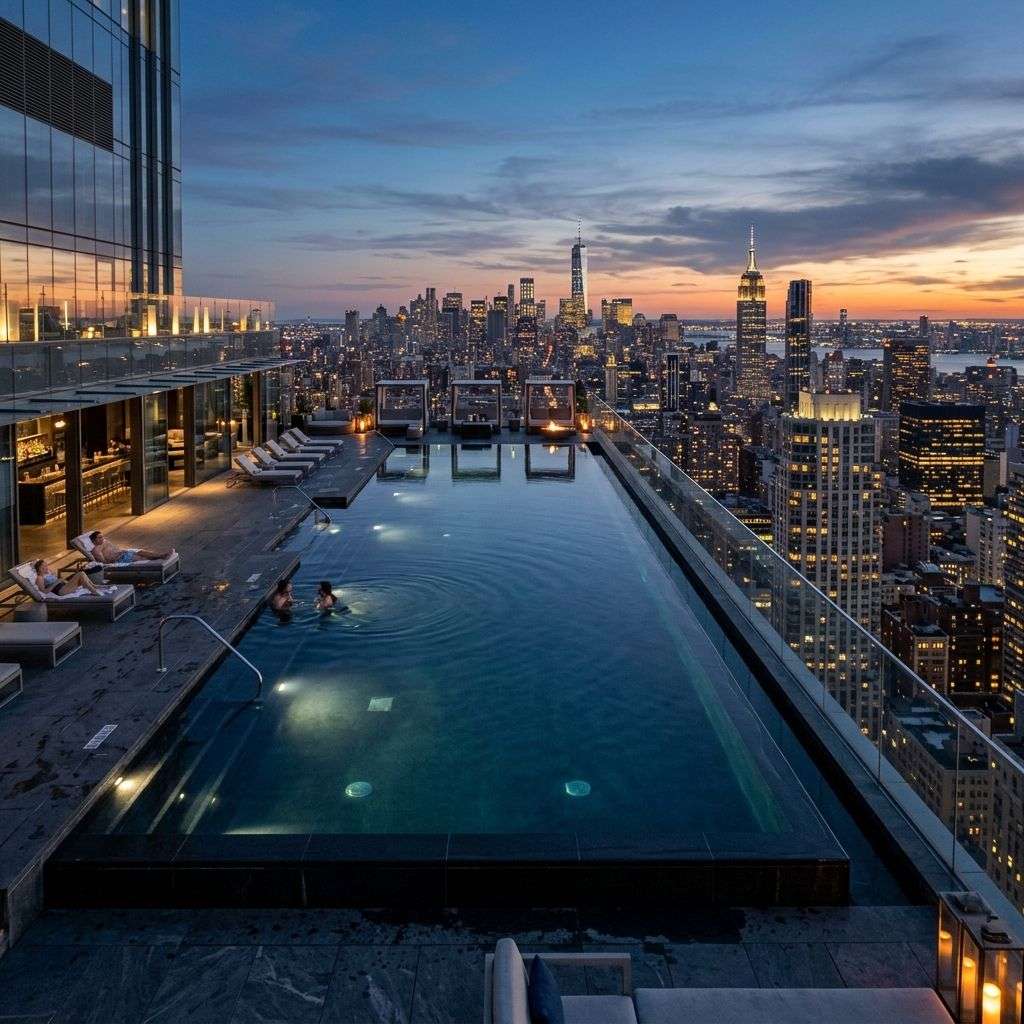
Commercial aquatic construction costs are frequently misunderstood by developer and procurement teams accustomed to residential or budget commercial work. A $500K quote and a $5M quote for two apparently similar pools is not evidence of dishonest bidding — it reflects dramatically different engineering scope, finish specification, and lifecycle economics. Here's a transparent breakdown of what drives commercial pool cost in Australia in 2026.
The Five Cost Drivers
Commercial pool cost is driven by five factors, in roughly decreasing order of impact:
- Vessel size and depth (concrete volume, reinforcement, excavation)
- Location and site conditions (reactive soil, rock, crane access, cyclone zone)
- Finish specification (tile grade, coping, decking)
- Plant and treatment systems (filtration capacity, sanitisation stack, heating)
- Compliance overlay (competition standards, DDA, heritage, acoustic)
Typical Cost Bands
Indicative 2026 commercial pool cost bands across Australia:
- Boutique estate 25m lap pool: $1.5 – 2.2M (custom finish, vanishing edge optional)
- Multi-storey rooftop infinity 20m: $2.5 – 3.8M (wind, acoustic, structural premium)
- Hotel resort lagoon 800 m²: $3.5 – 5.2M (multi-zone, spa integration, rapid delivery)
- 50m competition municipal with hydrotherapy: $7 – 9.5M (dimensional tolerance, dual plant)
- Commercial 25m learn-to-swim warehouse retrofit: $900K – 1.3M (freestanding vessel)
Per Square Metre Rates (Rough Guide)
For rapid feasibility at Stage 00, we use these indicative rates. They assume commercial specification, SEQ location, and standard ground:
- Structural pool shell + basic plant: $4,500 – 6,000 per m² of water surface
- Premium finish plus UV/Ozone treatment: +30-50% on base rate
- Rooftop/high-rise engineering premium: +60-120% on ground-level equivalent
- Competition dimensional tolerance: +15-25% on standard 50m
- DDA full compliance: +$50-120K for retrofit capability
What Budget Quotes Miss
Budget commercial quotes typically under-specify in these areas: geotechnical investigation (assumed standard ground), acoustic isolation (omitted for mixed-use builds), DDA compliance (treated as optional), filter sizing (under-sized for bather load), and commissioning (not included). Each omission eventually surfaces as variation or post-handover expense, often eliminating or reversing the original saving.
Conclusion
We quote transparent, class-graded estimates at every feasibility stage — with budget premium drivers called out explicitly. Procurement teams receive a breakdown that distinguishes scope, site, and specification impact on total cost.